seaborn.lmplot
seaborn.lmplot(x, y, data, hue=None, col=None, row=None, palette=None, col_wrap=None, height=5, aspect=1, markers='o', sharex=True, sharey=True, hue_order=None, col_order=None, row_order=None, legend=True, legend_out=True, x_estimator=None, x_bins=None, x_ci='ci', scatter=True, fit_reg=True, ci=95, n_boot=1000, units=None, order=1, logistic=False, lowess=False, robust=False, logx=False, x_partial=None, y_partial=None, truncate=False, x_jitter=None, y_jitter=None, scatter_kws=None, line_kws=None, size=None)
Plot data and regression model fits across a FacetGrid.
This function combines regplot() and FacetGrid. It is intended as a convenient interface to fit regression models across conditional subsets of a dataset.
When thinking about how to assign variables to different facets, a general rule is that it makes sense to use hue for the most important comparison, followed by col and row. However, always think about your particular dataset and the goals of the visualization you are creating.
There are a number of mutually exclusive options for estimating the regression model. See the tutorial for more information.
The parameters to this function span most of the options in FacetGrid, although there may be occasional cases where you will want to use that class and regplot() directly.
参数:x, y:strings, optional
Input variables; these should be column names in
data.
data:DataFrame
Tidy (“long-form”) dataframe where each column is a variable and each row is an observation.
hue, col, row:strings
Variables that define subsets of the data, which will be drawn on separate facets in the grid. See the
*_orderparameters to control the order of levels of this variable.
palette:palette name, list, or dict, optional
Colors to use for the different levels of the
huevariable. Should be something that can be interpreted bycolor_palette(), or a dictionary mapping hue levels to matplotlib colors.
col_wrap:int, optional
“Wrap” the column variable at this width, so that the column facets span multiple rows. Incompatible with a
rowfacet.
height:scalar, optional
Height (in inches) of each facet. See also:
aspect.
aspect:scalar, optional
Aspect ratio of each facet, so that
aspect * heightgives the width of each facet in inches.
markers:matplotlib marker code or list of marker codes, optional
Markers for the scatterplot. If a list, each marker in the list will be used for each level of the
huevariable.
share{x,y}:bool, ‘col’, or ‘row’ optional
If true, the facets will share y axes across columns and/or x axes across rows.
{hue,col,row}_order:lists, optional
Order for the levels of the faceting variables. By default, this will be the order that the levels appear in
dataor, if the variables are pandas categoricals, the category order.
legend:bool, optional
If
Trueand there is ahuevariable, add a legend.
legend_out:bool, optional
If
True, the figure size will be extended, and the legend will be drawn outside the plot on the center right.
x_estimator:callable that maps vector -> scalar, optional
Apply this function to each unique value of
xand plot the resulting estimate. This is useful whenxis a discrete variable. Ifx_ciis given, this estimate will be bootstrapped and a confidence interval will be drawn.
x_bins:int or vector, optional
Bin the
xvariable into discrete bins and then estimate the central tendency and a confidence interval. This binning only influences how the scatterplot is drawn; the regression is still fit to the original data. This parameter is interpreted either as the number of evenly-sized (not necessary spaced) bins or the positions of the bin centers. When this parameter is used, it implies that the default ofx_estimatorisnumpy.mean.
x_ci:“ci”, “sd”, int in [0, 100] or None, optional
Size of the confidence interval used when plotting a central tendency for discrete values of
x. If"ci", defer to the value of theciparameter. If"sd", skip bootstrapping and show the standard deviation of the observations in each bin.
scatter:bool, optional
If
True, draw a scatterplot with the underlying observations (or thex_estimatorvalues).
fit_reg:bool, optional
If
True, estimate and plot a regression model relating thexandyvariables.
ci:int in [0, 100] or None, optional
Size of the confidence interval for the regression estimate. This will be drawn using translucent bands around the regression line. The confidence interval is estimated using a bootstrap; for large datasets, it may be advisable to avoid that computation by setting this parameter to None.
n_boot:int, optional
Number of bootstrap resamples used to estimate the
ci. The default value attempts to balance time and stability; you may want to increase this value for “final” versions of plots.
units:variable name in data, optional
If the
xandyobservations are nested within sampling units, those can be specified here. This will be taken into account when computing the confidence intervals by performing a multilevel bootstrap that resamples both units and observations (within unit). This does not otherwise influence how the regression is estimated or drawn.
order:int, optional
If
orderis greater than 1, usenumpy.polyfitto estimate a polynomial regression.
logistic:bool, optional
If
True, assume thatyis a binary variable and usestatsmodelsto estimate a logistic regression model. Note that this is substantially more computationally intensive than linear regression, so you may wish to decrease the number of bootstrap resamples (n_boot) or setcito None.
lowess:bool, optional
If
True, usestatsmodelsto estimate a nonparametric lowess model (locally weighted linear regression). Note that confidence intervals cannot currently be drawn for this kind of model.
robust:bool, optional
If
True, usestatsmodelsto estimate a robust regression. This will de-weight outliers. Note that this is substantially more computationally intensive than standard linear regression, so you may wish to decrease the number of bootstrap resamples (n_boot) or setcito None.
logx:bool, optional
If
True, estimate a linear regression of the form y ~ log(x), but plot the scatterplot and regression model in the input space. Note thatxmust be positive for this to work.
{x,y}_partial:strings in data or matrices
Confounding variables to regress out of the
xoryvariables before plotting.
truncate:bool, optional
By default, the regression line is drawn to fill the x axis limits after the scatterplot is drawn. If
truncateisTrue, it will instead by bounded by the data limits.
{x,y}_jitter:floats, optional
Add uniform random noise of this size to either the
xoryvariables. The noise is added to a copy of the data after fitting the regression, and only influences the look of the scatterplot. This can be helpful when plotting variables that take discrete values.
{scatter,line}_kws:dictionaries
Additional keyword arguments to pass to
plt.scatterandplt.plot.
See also
Plot data and a conditional model fit.Subplot grid for plotting conditional relationships.Combine regplot() and PairGrid (when used with kind="reg").
Notes
The regplot() and lmplot() functions are closely related, but the former is an axes-level function while the latter is a figure-level function that combines regplot() and FacetGrid.
Examples
These examples focus on basic regression model plots to exhibit the various faceting options; see the regplot() docs for demonstrations of the other options for plotting the data and models. There are also other examples for how to manipulate plot using the returned object on the FacetGrid docs.
Plot a simple linear relationship between two variables:
>>> import seaborn as sns; sns.set(color_codes=True)
>>> tips = sns.load_dataset("tips")
>>> g = sns.lmplot(x="total_bill", y="tip", data=tips)

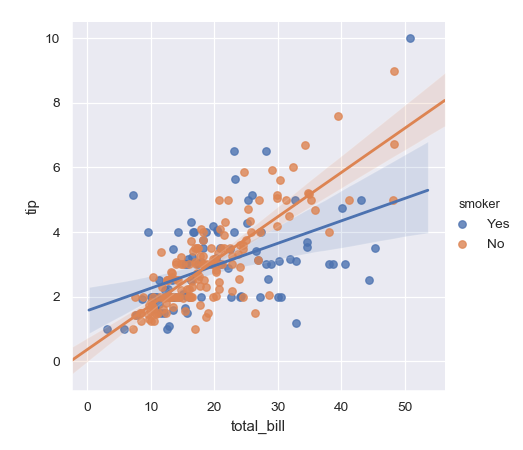
Condition on a third variable and plot the levels in different colors:
>>> g = sns.lmplot(x="total_bill", y="tip", hue="smoker", data=tips)
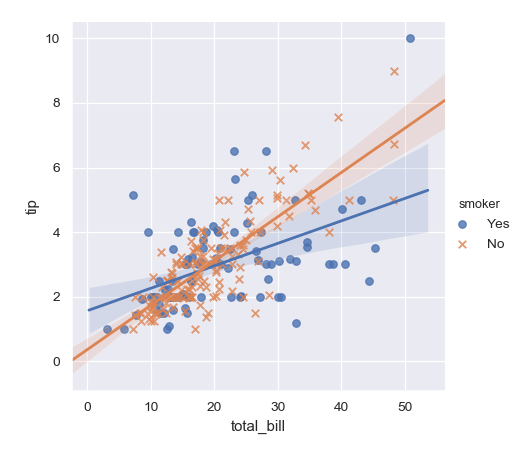
Use different markers as well as colors so the plot will reproduce to black-and-white more easily:
>>> g = sns.lmplot(x="total_bill", y="tip", hue="smoker", data=tips,
...                markers=["o", "x"])
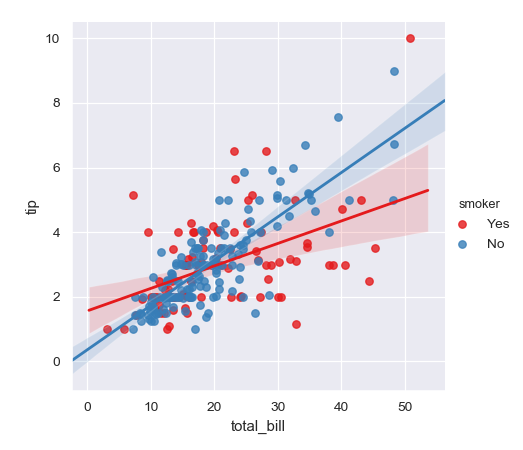
Use a different color palette:
>>> g = sns.lmplot(x="total_bill", y="tip", hue="smoker", data=tips,
...                palette="Set1")
Map hue levels to colors with a dictionary:
>>> g = sns.lmplot(x="total_bill", y="tip", hue="smoker", data=tips,
...                palette=dict(Yes="g", No="m"))

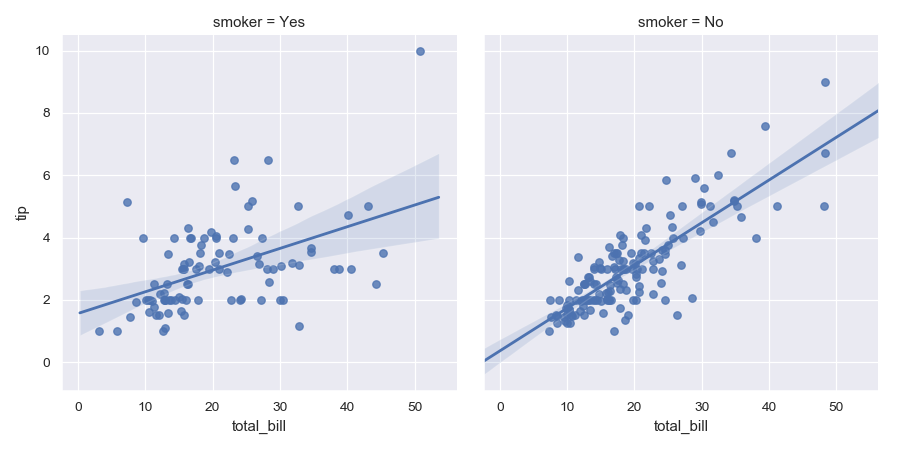
Plot the levels of the third variable across different columns:
>>> g = sns.lmplot(x="total_bill", y="tip", col="smoker", data=tips)
Change the height and aspect ratio of the facets:
>>> g = sns.lmplot(x="size", y="total_bill", hue="day", col="day",
...                data=tips, height=6, aspect=.4, x_jitter=.1)

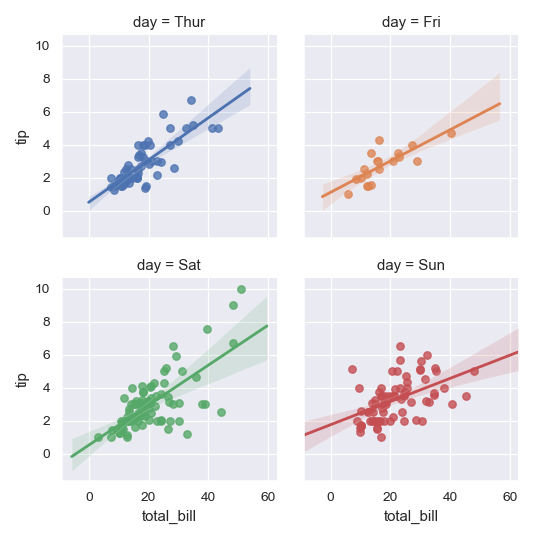
Wrap the levels of the column variable into multiple rows:
>>> g = sns.lmplot(x="total_bill", y="tip", col="day", hue="day",
...                data=tips, col_wrap=2, height=3)
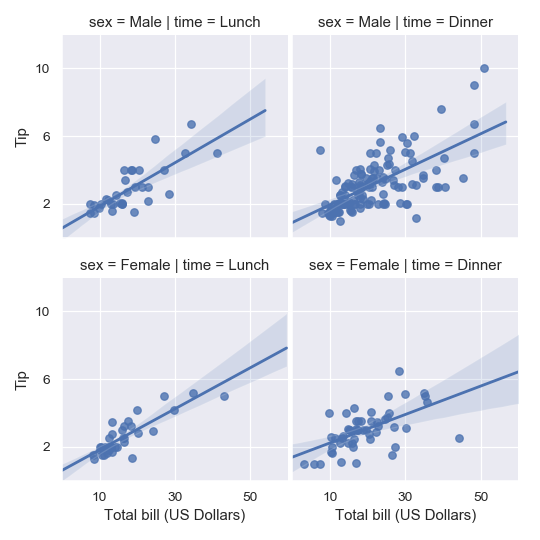
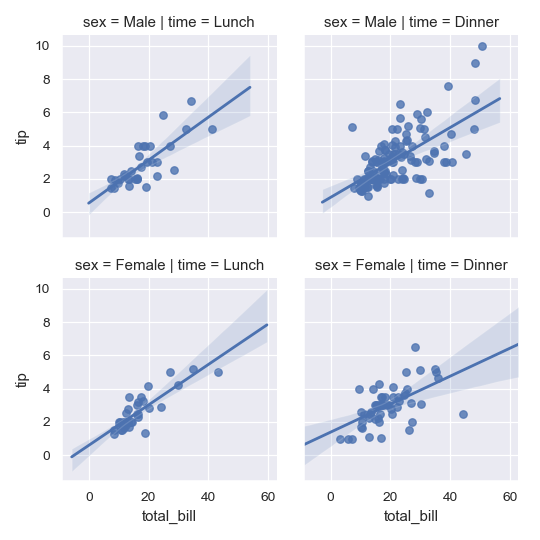
Condition on two variables to make a full grid:
>>> g = sns.lmplot(x="total_bill", y="tip", row="sex", col="time",
...                data=tips, height=3)
Use methods on the returned FacetGrid instance to further tweak the plot:
>>> g = sns.lmplot(x="total_bill", y="tip", row="sex", col="time",
...                data=tips, height=3)
>>> g = (g.set_axis_labels("Total bill (US Dollars)", "Tip")
...       .set(xlim=(0, 60), ylim=(0, 12),
...            xticks=[10, 30, 50], yticks=[2, 6, 10])
...       .fig.subplots_adjust(wspace=.02))